by Ramon De La Puerta (Z-Lounge Regenerative Medicine and Stem Cell Therapy Centers)
If you’re researching stem cell therapy, you might notice a curious trend: many patients from the US and Canada are flying to places like Mexico for umbilical cord MSC treatments. Why not get it done at home? This article explains the key reasons — from regulatory roadblocks and cost differences to the availability of cutting-edge care — that North Americans are heading south for UC-MSC therapy. Understanding this trend will help you weigh your options if you’re considering treatment.
The Regulatory Puzzle: FDA and Health Canada Restrictions
UC-MSCs (and most stem cell therapies) are tightly regulated in the United States and Canada. As of 2025, neither country’s regulators have broadly approved umbilical cord MSC therapy for common conditions like arthritis or autoimmune diseases. Here’s why this matters:
- FDA Rules: The FDA classifies most stem cell therapies as biologic drugs that require extensive trials and approvals. They only fully approve a few stem cell uses (like bone marrow transplants for certain cancers). The FDA also has a “minimal manipulation” rule—meaning cells that are more than minimally processed (expanded in culture, for example) can’t be used without approval. UC-MSC treatments typically involve expanding cells to get a high dose, which is not allowed outside clinical trials in the US.
- Health Canada: Similar to the FDA, Canada treats these therapies as drugs. While some autologous (your own) cell treatments happen under experimental exemptions, allogeneic UC-MSC therapy isn’t openly available except in research studies.
In short, even though promising research exists, UC-MSC therapy is still considered “investigational” in the US/Canada. Neil Riordan, a pioneer in stem cells, put it bluntly: “I don’t see FDA loosening regulations any time soon, so I have no plans to do anything in the U.S. using umbilical cord MSCs.” Many doctors share this frustration, which is why progressive stem cell clinics operate in Panama and Mexico instead of Dallas or Toronto.
For patients, this means if you want UC-MSC therapy for, say, your knee osteoarthritis or MS, you cannot simply get it from your local hospital or clinic in the US/Canada (aside from enrolling in a clinical trial, where you might get placebo and have a 50/50 chance of receiving the cells).
Approved Uses Are Limited at Home
To further clarify, current approved stem cell uses in North America include:
- Bone marrow or cord blood transplants for blood cancers and disorders.
- Autologous bone marrow concentrate for orthopedic use in some cases (treated as minimal manipulation if done same-day).
Treatments for conditions like autism, Parkinson’s, stroke, and chronic arthritis using stem cells are not approved. This regulatory conservatism — aimed at safety — ironically drives patients to seek treatment elsewhere.
A telling statistic is that at one leading stem cell clinic in Cancun, Americans and Canadians make up ~70–75% of patients. This is not because there are no patients at home; it’s because the therapy isn’t easily obtainable at home.
Cost: Treatment South of the Border Is More Affordable
Medical tourism often comes down to cost. Stem cell therapy is rarely covered by insurance in the US or Canada (since it’s not standard of care yet). Out-of-pocket prices can be steep. However, in Mexico, the cost of UC-MSC therapy is generally a fraction of the U.S. price:
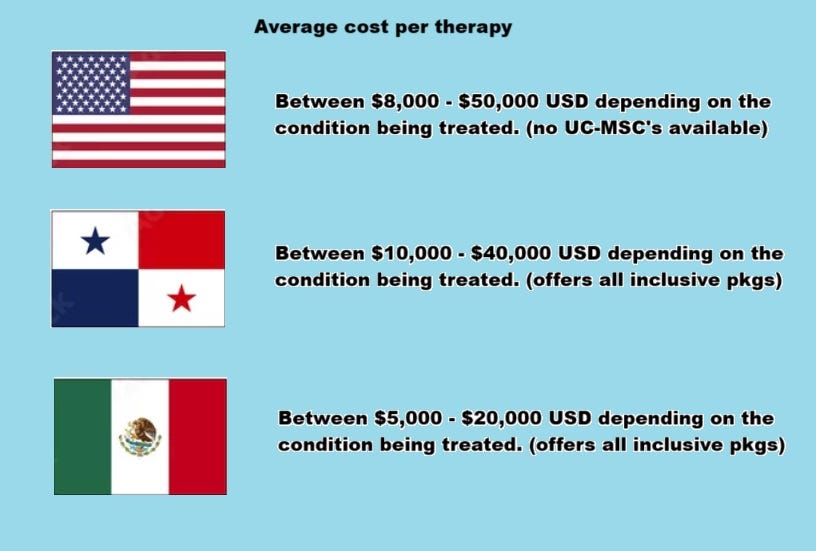
- A complete stem cell treatment series in the USA might run $20,000 to $50,000 (and often on the higher end if multiple injections are needed). Some specialized clinics charge even more for bespoke treatments.
- In Mexico, reputable clinics offer UC-MSC therapy for around $4,500 to $15,000, depending on the number of cells and treatment sessions. That can be 50–80% cheaper than U.S. prices for a comparable or even larger dose of cells.
Why the difference? A few factors:
- Lower operating costs: Mexico’s medical facilities and lab costs are generally lower.
- Efficiencies in cell processing: Mexican regulations allow labs to culture and expand cells in-country without the same red tape, which lowers cost per million cells.
- Competition and volume: Places like Tijuana and Cancun have multiple clinics (competition can drive down price), and they treat international patients in volume, which can reduce cost per patient.
For many middle-class patients, a $25k treatment at home is simply unaffordable, whereas an $8k to $10k trip to Mexico (even after travel expenses) might be within reach.
Consider an example: A patient with arthritis who was quoted $40,000 for an adipose stem cell procedure in the US (not covered by insurance) could get a UC-MSC procedure in Mexico for under $10,000, including airfare and hotel. That’s compelling.
Availability and Advanced Treatment Approaches
Even if money isn’t an issue, the availability of the treatment is key. In the U.S. or Canada, you might find a few regenerative medicine clinics offering something akin to MSC therapy. Still, often they’re limited to using your cells (bone marrow or fat) to stay within regulations. These treatments might yield fewer active stem cells than an expanded UC-MSC product.
In Mexico, clinics can legally offer UC-MSC therapy now, not 5–10 years from now when trials finish. This means:
- Higher cell doses: Mexican regulations (through COFEPRIS, their health authority) permit labs to culture cells to high numbers. Patients might receive 100–300 million UC-MSCs per treatment, a dose typically not feasible in a same-day U.S. procedure where only ~10–50 million autologous cells might be harvested.
- Multiple administration routes: Clinics can administer cells intravenously, intrathecally (into spinal fluid for neuro conditions), or intra-articularly (into joints), as needed. In the U.S., any of those beyond IV in a trial would be a regulatory no-go.
- Innovation: Because of a more open framework, clinics in Mexico often adopt the latest protocols — e.g., combining UC-MSCs with adjunct therapies like growth factors or using “Propietary Cells™” (a term some clinics use for selecting particularly potent MSCs). They aren’t stuck waiting years for each incremental innovation to be approved.
- Immediate Access: You don’t need to try to enroll in a trial or petition for compassionate use. If you qualify medically (no major contraindications), you can book a treatment in weeks rather than potentially waiting years.
To illustrate, Stem Cell Clinics in Cancun offer autologous MSC treatments for various conditions and get many American patients specifically because these patients can’t obtain similar therapies at home. Similarly, clinics like Stem Cell Institute (Panama, founded by Riordan) and others in Mexico have catered to thousands of North Americans who couldn’t wait for domestic approval.
One might ask: Are these Mexican clinics cutting corners? The best ones operate at high standards:
- They are overseen by COFEPRIS, which requires proper licensing (laboratory licenses, clinic licenses) and GMP (Good Manufacturing Practice) standards for cell processing.
- For example, Z-Lounge Regenerative Medicine operations highlight that they use ISO-certified, cGMP labs for their cell expansions and have treated over 3,000 patients with a strong safety record.
- Doctors in these clinics are often US-trained or internationally certified, and many clinics cater to medical tourists with English-speaking staff and patient coordinators.
Of course, like any medical tourism, due diligence is needed—there are always some less scrupulous providers. But many Mexican stem cell centers have track records published in patient testimonials and even scientific publications.
Personal Stories Driving the Trend
Stories of high-profile patients and regular folks alike have fueled interest:
- Gordie Howe (Hockey legend) — Although his treatment involved a different type of stem cell (neural stem cells) and was in a clinical trial setting in Tijuana, his dramatic recovery from stroke in 2014 made headlines. It showcased that cutting-edge stem cell treatments were being done in Mexico when they weren’t available in the US, inspiring others to look abroad.
- Patients with MS—Numerous American MS patients have blogged their journeys to clinics like Stem Cell Institute in Panama or Mexico for UC-MSC therapy, reporting improvements in fatigue, mobility, or MRI results. These personal success stories circulate in disease communities.
- Children with Autism or Cerebral Palsy — Again, not our primary focus group (over 45), but it’s worth noting parents have taken kids to Mexico for UC-MSC therapy for autism, etc.. When they share improvements, it further normalizes the concept of going abroad for care. This indirectly affects how open older adults are to doing the same for their issues.
One telling quote from a U.S. patient: “The U.S. is missing out — I got my life back after stem cells in Cancun, something I couldn’t even try at home.” This sentiment is echoed by many who felt they had exhausted conventional treatments domestically and saw medical tourism as a beacon of hope.
Different Rules, Same Safety?
A reasonable concern is whether these treatments in Mexico are safe, given they’re not FDA approved. The short answer from available data: yes, they appear comparably safe when done at reputable clinics. Many Mexican providers publish data or adhere to the same protocols as clinical trials. For instance:
- The cells are typically processed in sterile labs and tested for contamination.
- Doses and administration techniques are similar to those used in clinical trials that reported good safety.
- COFEPRIS oversight, while not identical to the FDA, still requires adverse event reporting and follow-up.
However, patients must choose clinics carefully. Some tips:
- Look for clinics that have doctors who are board-certified and trained in the U.S. or Mexico.
- Ensure the clinic has an established track record (years in business, many patients, testimonials).
- Ask about the source of their UC-MSCs (reputable cell bank? Full donor screening?).
Many Mexican clinics will gladly share quality certifications if asked. Remember, legitimate providers thrive on good outcomes and word-of-mouth in the international community, so they uphold high standards.
Other Factors: Holistic Experience and Personalized Care
Patients often mention that the experience abroad was very positive, not just because of the treatment, but how it was delivered:
- Mexican medical staff are frequently praised for being warm, attentive, and holistic in their care approach. One comparison some make: in the US, you might feel like a number in a system; at a private clinic in Mexico, you’re treated “like family.” (Of course, experiences vary, but this is a common refrain).
- Many clinics include airport pick-up, a patient concierge, and sometimes even tourist activities if you’re up for it. It can feel more like a healing retreat.
- The psychological boost of traveling for care can play a role — patients often approach it with hope and positivity, which can improve outcomes in any treatment (mind-body effect and placebo contribution).
- Some clinics integrate wellness therapies (IV vitamins, hyperbaric oxygen, physical therapy, etc.) around the stem cell treatment, enhancing overall results and making patients feel better cared for.
Consider an older patient with painful knees: In the US, they might get a 15-minute injection in a clinic and go home. In Mexico, the same patient might get a multi-day program—one day of evaluations and IV infusions, the next day the stem cell injections, plus massage or physical therapy, and a nice hotel to recover in by the beach. The latter scenario is understandably more appealing and may even aid recovery thanks to reduced stress.
Summarizing the Pull Factors
Let’s recap the main reasons Americans and Canadians are opting for UC-MSC therapy in Mexico:
- Access to Treatment: UC-MSC therapy is available now, without waiting for years of regulatory approval.
- Fewer Restrictions: Ability to use cultured cells at high doses and treat a broader range of conditions (beyond what’s allowed back home).
- Cost Savings: Treatments can be much more affordable, often 50–70% less than U.S. prices.
- Quality Care: Many clinics offer world-class medical care, with skilled doctors and accredited labs that meet international standards.
- Patient Experience: A supportive, concierge-level patient-centered experience, which can be exceptionally comforting for older patients.
- Word of Mouth: Growing testimonials and success stories from other patients, making people more confident to take the leap.
There are also reasons for caution (not everyone is comfortable traveling for medical care, and some prefer the oversight of FDA trials). But clearly, thousands have decided that the potential benefits outweigh the uncertainties.
As stem cell tourism grows, the FDA and Health Canada face pressure — are they “missing a trick,” as one article posed? While they prioritize safety and evidence, patients with severe chronic conditions are often willing to accept some uncertainty in exchange for a chance at relief. Thus, the flow of medical tourists continues.
If you’re considering UC-MSC therapy, understanding this landscape is essential. Many top clinics offer free phone consultations to discuss their protocols, which can help you make an informed choice. Always consult your home physician to coordinate care and ensure you’re a good candidate to travel.
Let’s Stay Connected!
If you found this article helpful and want to learn more about regenerative medicine, stem cell therapy, and biohacking for longevity, follow me across platforms:
Website: www.zlounge.com.mx
Instagram: https://tinyurl.com/Z-Lounge-IG
Facebook: https://tinyurl.com/Z-Lounge-FB
YouTube: https://tinyurl.com/Z-Lounge-YT
LinkedIn: https://tinyurl.com/Z-Lounge-Linkedin
Subscribe on Medium to get notified when I publish new content written to empower your health journey.
Bibliography:
- Whiteman, H. (2016, Feb 25). Stem cell therapy: Is the US missing a trick? Medical News Today. (Discusses Americans traveling to Cancun for stem cells) medicalnewstoday.com
- Riordan, N. (2014). Neil Riordan on opening a stem cell clinic in the US. CellMedicine.com. (Q&A where Dr. Riordan explains FDA regulatory hurdles)
- COFEPRIS Regulations — Mexican General Health Law for Health Products, Title on cells, 2014 (summarized by R3 Stem Cell): Permits use of minimally manipulated cells under guidelines, allowing licensed clinics to offer therapies within Mexico.
- Stem Cell Institute (Panama). (n.d.). Patient statistics. (Not publicly cited here, but general knowledge: majority of patients from US/Canada)
- Chan, R. (2016, June 10). What to know about Gordie Howe’s stem cell treatment. Time Magazine.
- Multiple Sclerosis News Today. (2018). UC-MSC treatment safe & beneficial in MS trial. (Reports on a Panama trial that many US patients participated in)
- Ramirez, C. (2021). Personal testimonial — Stem cells in Mexico. (Blog post, anecdotal) — “I felt cared for and safe, the process was smooth, and I’m walking better than I have in years.”
- Global Newswire. (2019). New Japanese regenerative medicine law and implications. (Context on international regulation differences)